Benefits Monthly Minute
Happy Thanksgiving! In the November Monthly Minute, we are giving thanks for the finalized IRS auto-enrollment regulations, new qualified plan limits and taking a look at a recent $12.9M mental health parity settlement against Anthem.
Anthem Settles Mental Health Parity Suit for $12.9M
Earlier this month, a New York federal court gave final approval to a class action settlement against Anthem that applies to approximately 19,000 Anthem members. In the Collins v. Anthem case, originally filed in April 2020, plaintiffs alleged that Anthem denied class members’ requests for coverage of residential treatment on the basis that the care was not medically necessary, used medical necessity criteria that were inconsistent with generally accepted standards of care and applied more restrictive standards than were used for comparable medical/surgical care. The court approved the settlement on November 5, 2026, wherein Anthem agreed to pay nearly $12.9M to eligible class members that had paid out of pocket for their treatment.
KMK Comment: This sizeable settlement is a stark reminder that mental health-related claims administration remains a high-risk area for claims administrators, and the consequences can be severe. Plan administrators should work with counsel to consistently monitor claims administration for compliance with mental health parity rules. A key place to start would be to confirm that the plan’s mental health parity testing is up-to-date, and that plan administrators are reviewing testing reports and closing compliance gaps where appropriate.
IRS Releases Final Regulations Implementing SECURE 2.0 Auto-Enrollment Expansion
On November 16, the IRS released final rules on automatic enrollment requirements. The new regulations reflect SECURE 2.0’s statutory changes under IRC 414A that expand eligible automatic contribution arrangements (EACAs) in employer-sponsored 401(k) and 403(b) plans (the mandate only applies to plans established on or after December 29, 2022). The regulations affect participants in, beneficiaries of, employers maintaining, and administrators of certain retirement plans and generally apply to plan years that begin after December 31, 2027.
The final rules require covered retirement plans to automatically enroll eligible employees at an initial 3% default contribution rate, and after an initial participation period, the rate must increase by at least 1% per year until it reaches at least 10% (there is a 15% maximum). However, employees are permitted to opt out or elect a different contribution rate, and plans are not required to override existing employee contribution rate elections.
The final regulations also:
- Provide detailed rules addressing the statutory exceptions for small and new businesses, governmental plans, church plans, and SIMPLE 401(k) plans. For example, related employers must be aggregated when applying the small business exception. Note that the IRS did not permit certain employee categories (e.g., collectively bargained employees) to be excluded from the new rules.
- Offer some flexibility as to timing and amount of automatic contribution increases. Notably, plans may increase contribution rates by more than 1% and may reset employee default elections in certain rehire contexts.
- Allow certain required notices to be combined and reduce annual notice requirements for qualifying non-participating employees (as long as they are given annual reminders and plan documents on request).
- Explain how automatic enrollment requirements apply following plan mergers.
KMK Comment: Although Section 414A of SECURE 2.0 is already in effect, the final regulations generally apply to retirement plan years beginning after December 31, 2027. Accordingly, employers have some time to work with plan service providers and legal counsel make necessary operational changes and plan document updates.
Qualified Plan Limit Increases for 2027
On November 12, 2026, the IRS announced new qualified plan limits in Notice 2026-66. At a glance, the key changes from 2026 to 2027 are as follows:
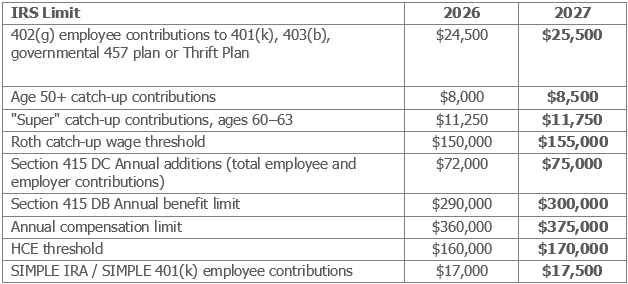
KMK Comment: New limits, new document updates! Plan administrators are reminded to timely communicate these changes to participants and ensure that plan documents and enrollment materials reflect the latest IRS limits.
The KMK Law Employee Benefits & Executive Compensation Group is available to assist with these and other issues.
Lisa Wintersheimer Michel
513.579.6462
lmichel@kmklaw.com
John F. Meisenhelder
513.579.6914
jmeisenhelder@kmklaw.com
Antoinette L. Schindel
513.579.6473
aschindel@kmklaw.com
Kelly E. MacDonald
513.579.6409
kmacdonald@kmklaw.com
Rachel M. Pappenfus
513.579.6492
rpappenfus@kmklaw.com
KMK Employee Benefits and Executive Compensation email updates are intended to bring attention to benefits and executive compensation issues and developments in the law and are not intended as legal advice for any particular client or any particular situation. Please consult with counsel of your choice regarding any specific questions you may have.