
EPA Extends Key Workplace Chemical Protection Deadlines for PCE and Carbon Tetrachloride into 2027: What Businesses Need to Know
If your company operates a vapor degreaser, runs a cold-cleaning line, or uses perchloroethylene (PCE) in any industrial or commercial process, a federal rule that took effect on July 28, 2026, has a direct impact on your compliance calendar.[1] The U.S. Environmental Protection Agency published a final rule extending several Workplace Chemical Protection Program (WCPP) compliance dates under the Toxic Substances Control Act (TSCA) for PCE and CTC. The extension applies to non-federal owners and operators and aligns their deadlines with those already in place for federal agencies and their contractors.
This is welcome news for facilities facing resource constraints and overlapping regulatory timelines. But make no mistake: the extension buys planning time, not a compliance holiday. The Agency’s underlying finding that PCE and CTC present unreasonable risk to human health remains unchanged, and every substantive WCPP requirement still applies—just on a revised schedule.
What the Final Rule Does
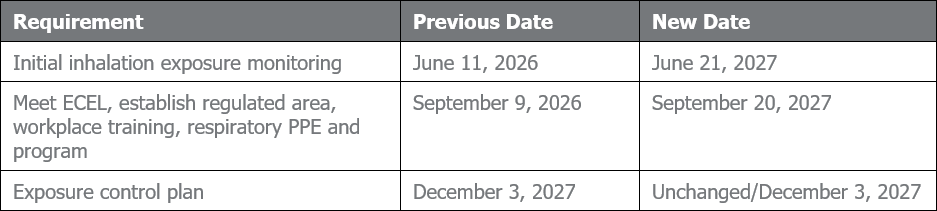
Effective immediately on its publication date, the rule pushes back certain WCPP deadlines for non-federal facilities that use PCE or CTC. EPA cited two principal reasons for the extension: first, facilities subject to multiple WCPPs may face resource constraints and logistical challenges when overlapping requirements fall on separate timelines; second, for CTC specifically, limitations with available monitoring methods make it difficult to measure short-duration task exposures adequately.
The WCPP is EPA’s workplace safety framework for covered ongoing chemical uses. It includes requirements for exposure monitoring, airborne exposure limits, regulated areas, respiratory protection, workplace information and training, and exposure control planning. The Existing Chemical Exposure Limit (ECEL) sets a cap on how much of the chemical workers may breathe over a typical eight-hour work shift—0.14 parts per million (ppm) for PCE and 0.03 ppm for CTC.
Revised Compliance Dates at a Glance
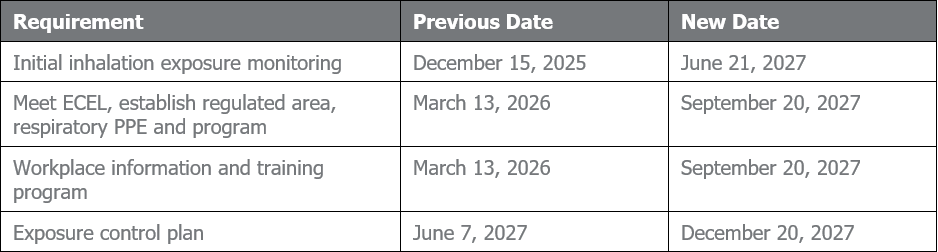
Perchloroethylene (PCE) — Non-Federal Owners and Operators[2]
Carbon Tetrachloride (CTC) — Non-Federal Owners and Operators[3]
What Still Applies During the Extension Period
EPA made clear that this timeline adjustment does not weaken existing protections or change the ultimate level of protection required. Several important points deserve attention:
- Dermal protection deadlines were not extended for either PCE or CTC. If your process involves skin contact with these chemicals, those requirements remain on their original schedule.
- EPA’s unreasonable-risk finding for PCE and CTC stands. The agency is not reconsidering whether these chemicals pose unacceptable health hazards—only the timeline for compliance.
- For PCE, the workplace information and training date for both federal and non-federal entities is extended to September 20, 2027, to align with respiratory protection provisions.
- New PCE users who introduce the chemical into the workplace after June 21, 2027, must comply with the ECEL beginning four months after introduction or September 20, 2027, whichever is later.
What This Means for Your Business
For companies operating vapor degreasers—equipment that uses solvent vapor to remove oils and contaminants from metal parts—or cold-cleaning lines, which wash or soak parts in liquid solvent at or near room temperature, the extension provides additional time to thoughtfully and preemptively work towards compliance. Both regulated processes can generate workplace inhalation and skin-contact exposure pathways that fall squarely within the WCPP.
Here is how to use the additional time wisely:
- Inventory your PCE footprint. Identify every material, process, and piece of equipment that introduces PCE into the workplace. Include aerosol degreasers, brake cleaners, lubricants, adhesives, and wipe cleaners—not just large-scale equipment.
- Map your exposure pathways. Determine who is potentially exposed, through what routes (inhalation and dermal), and during which tasks.
- Schedule monitoring early. Initial inhalation exposure monitoring is now due by June 21, 2027. Qualified industrial hygienists book well in advance. Do not wait until spring 2027 to start the process.
- Evaluate engineering controls. Assess whether your current ventilation, enclosure, substitution options, or administrative controls can meet the 0.14 ppm ECEL for PCE. If they cannot, plan capital improvements now.
- Build your compliance documentation. Prepare for regulated areas, training programs, respiratory protection program elements, and recordkeeping requirements. Preserving records of monitoring decisions and control evaluations protects you if questions arise later.
- Coordinate across teams. WCPP compliance touches operations, environmental health and safety, procurement, and legal. Align these functions early so no one department is scrambling alone at deadline.
Take Action Now
The extended deadlines are a planning opportunity, not an invitation to delay. Both the PCE and CTC rules remain the subject of ongoing litigation, and EPA has signaled that substantive rule updates are likely.[4] Businesses that treat the extension as dead time risk being caught off guard by further regulatory changes or by the hard deadlines themselves.
We encourage every company with PCE or CTC in its operations to assess its current compliance posture now, use this extension period intentionally, and engage environmental counsel before assuming that a process, product, or facility falls outside the rule’s reach. The costs of proactive preparation are far less than the costs of reactive scrambling—or enforcement.
For questions about how this rule affects your operations, please contact:
James C. Kezele
513.579.6598
jkezele@kmklaw.com
[1] See Perchloroethylene (PCE) and Carbon Tetrachloride (CTC); Regulation under the Toxic Substances Control Act (TSCA); Compliance Date Extensions, 91 Fed. Reg. 47145 (July 28, 2026), available at https://www.govinfo.gov/content/pkg/FR-2026-07-28/pdf/2026-15192.pdf
[2] See 40 C.F.R. § 751.607 for more details.
[3] See 40 C.F.R. § 751.707 for more details.
[4] See Fabriclean, et al, v. U.S. EPA, No. 25-60006 (5th Cir.) (currently held stayed following motion by EPA asking the court to give the agency time to develop new proposed rules to amend the 2024 PCE Rule which are expected in 2027. On June 22, 2026, the court granted the agency’s motion and stayed the case another 90 days.
KMK Law articles and blog posts are intended to bring attention to developments in the law and are not intended as legal advice for any particular client or any particular situation. The laws/regulations and interpretations thereof are evolving and subject to change. Although we will attempt to update articles/blog posts for material changes, the article/post may not reflect changes in laws/regulations or guidance issued after the date the article/post was published. Please consult with counsel of your choice regarding any specific questions you may have.
ADVERTISING MATERIAL.
© 2026 Keating Muething & Klekamp PLL. All Rights Reserved
